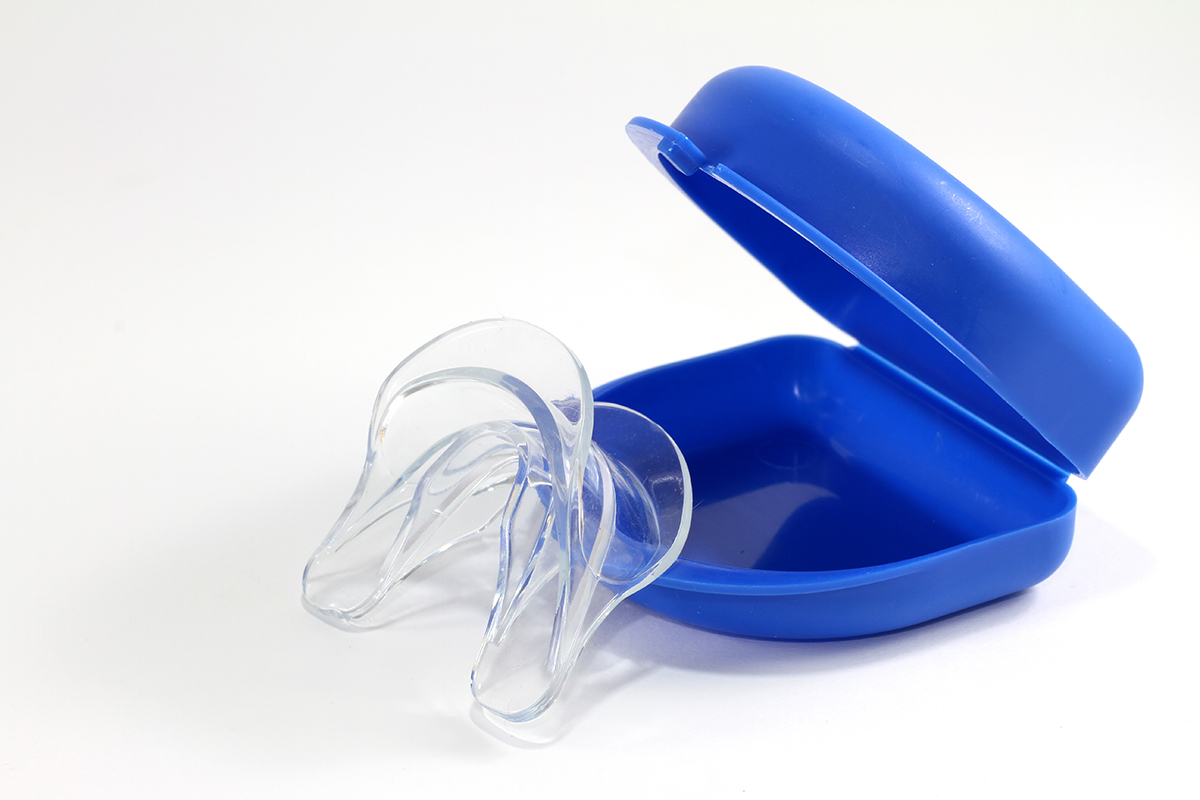
Athletic Mouth Guards

Mouth guards protect the teeth from injury during contact sports.  Most commonly used in football, mouth guards can provide protection in a variety of other sports.  Not only do they help prevent oral/facial injuries, mouth guards are currently being researched to decrease the rate of concussions.  

There are 3 types of mouth guards; stock, boil and bite, and custom mouth guards made by a dentist.

  • Stock Mouth Guards
    These mouth guards are the cheapest and least protective.  They are ready to use right out of the package.  They are uncomfortable and don't fit properly.  Athletes often cut them to fit better which loses it's limited protective function.
  • Boil and Bite Mouth Guards
    Exactly what the name implies.  Boil and bite mouth guards are removed from the package, boiled in water to soften the material, and molded to the teeth with finger pressure and biting into it.  Although better than stock guards, they are not recommended.  Reports have shown that boil and bite mouth guards provide a false sense of protection because of the 70-99% decrease in thickness.*  For proper protection, the material needs to maintain it's thickness.  Biting into the material results in the posterior teeth nearly touching or actually contacting.  A blow to the chin would result in a fracture of the posterior teeth or worse a concussion.
  • Custom Mouth Guards
    An impression is taken of the athlete's mouth.  These mouth guards are then either vacuum formed or pressure laminated to the mold from the impression.  Custom mouth guards give a precise fit, provide optimal protection, and last longer than the previous options.  Because of the durability, athletes can use one custom mouth guard rather than multiple other mouth guards during the year.

Can mouth guards be used with braces?  Definitely.  A little more care is taken to avoid the brackets.  They are highly recommended after braces because they adapt closer to the teeth.  Plus it would be wise to protect the investment made through the years of orthodontic work.

How to care for your custom mouth guard. (Recommendations by the ADA)

  1.  Rinse before or after each use or brush with a toothbrush and toothpaste
  2. Occasionally clean the mouth guard in cool soapy water and rinse thoroughly
  3. Transport the mouth guard in a sturdy container that has vents
  4. Never store in the sun or place in hot water
  5. Check for wear occasionally and replace when necessary

*Joon Park, PhD, et al.  First International Symposium on Biomaterials, Aug 1993.